Thursday, July 31, 2008

Traveling the Left Coast


Oregon is the best west coast state for a casual tourist to drive. Of course, I’m disregarding Alaska, an anomaly whose size, weather conditions, rugged or mushy terrain, and limited accessibility make it incomparable to anyplace else in the U.S.

Oregon, unlike either Washington or California, has an abundance of small cities and comfortable towns along her north-south auto artery, easier for a car-bound stranger to negotiate than either the huge cities or trackless wastes of California. The corporate footprint is present, but generally not overwhelming in Oregon towns, and the traveler looking for a “mom and pop” motel, restaurant, or grocery can find them in places like Medford, Cottage Grove, and Albany.

The climate, except for the broad Valley of the Mighty Willamette, is cool in the summer and mild in the winter, and there are rest stops at intervals of 20-plus miles all along the well-maintained freeway corridor, which begins with a convenient bypass around the metropolis of Portland and enters California at the rugged Siskiyou Pass. The mountainous scenery through most of the state’s southern half is lovely, and the northern half’s flat plain (the two contiguous valleys of the Columbia and the Willamette), while not as beautiful as the mountains, is attractive in its own way.

If you’ve got time and you’re in no hurry, the beauties of the Oregon coast offer a completely different, and delightful (though heavily populated) kind of scene. The entire coastline is park, owned and administered exclusively by the state.

Washington is also much easier on the traveler than California, but it is wetter, often colder, more crowded, and less given to public works than Oregon. California is an ordeal to travel, although it’s interesting watching the Golden State’s intensifying problems, chiefly ecological and financial, intensify into a death spiral.

Tuesday, July 29, 2008

Psych Slums

An out of work truck driver on the verge of losing his food stamps carried a shotgun into a Unitarian-Universalist Church in Knoxville while the church's kids were performing the musical "Annie," and shot the place up. He killed two and injured more than half a dozen before parishioners took him down.

According to people who know Jim D. Adkisson, he is obsessed with homosexuality and "the liberal movement," and the UU Church nationwide has publicized its willingness to provide a spiritual refuge for gays and lesbians. Also, Adkisson's ex-wife once attended the Knoxville Church, although she hasn't gone there for years.

This story hits close to home, since I've always been and always will be a Unitarian, although I'm no longer a member of the UU Church.

According to the AP story covering this incident, "Adkisson was a loner who hates 'blacks, gays and anyone different from him,' longtime acquaintance Carol Smallwood of Alice, Texas, told the Knoxville News Sentinel." Apparently his hatred extends to anyone who is offensively tolerant and refuses to exhibit the proper degree of judgmentalism.

He's also a prime example of what Carl Gustav Jung was talking about when he described psychological projection, or the tendency of the weak-minded or dishonest among us to avoid confronting their internal conflicts, or even self-hatred, by projecting these things onto others. Jung sometimes called this avoidance of the "shadow self."

You don't have to be a certifiable dumb shit to engage in this weak behavior; millions of otherwise intelligent people in this country engage daily in an obsessive and irrational hatred of Islam and Arabs. But for a person to descend into the deeper forms of projection, it helps to be stupid, and morons can be dangerous.

Sunday, July 27, 2008

Endless War and Total Incomprehension


In the Valley of Elah, where David, the boy who would later become king, killed Goliath, good clearly triumphed over evil, and virtue overcame brute corruption. For the retired master sergeant played by Tommy Lee Jones in Paul Haggis's "In the Valley of Elah," the simple lessons of the Bible story summarized all his values and beliefs, which centered on loyalty, courage, and duty to one's country.

But when his son is murdered near the military base where he is stationed shortly after returning from a tour of duty in Iraq, Sgt. Deerfield holes up in a motel near the scene of the crime to run his own investigation (he's ex-CID), and as he begins to find out more about both his son and the war than he wants to know his universe begans to unravel.

Assisted by a local civilian detective (Charlize Theron), Sgt. Deerfield watches video of his son's tour of duty retrieved from his cell phone, and descends into the anarchy and senselessness of the damaged lives and psyches of the Iraq veterans he must deal with as he and Detective Sanders haltingly solve the murder through a painful process of elimination.

In the end Deerfield's view of the world lies in ruins, demolished by the realization that the mindless and meaningless violence of Iraq has mortally wounded even the war's survivors. These men are identical with those to whom Erich Maria Remarque dedicated his great World War I novel, "All Quiet on the Western Front" with the simple notation that the book was for "the men, who even if they may have escaped shells, were destroyed by the war".

This is a complex and subtle film because it deals with complex subjects. The script and Haggis's direction are equal to the difficulties of the topic, and avoid simplifying the issues under examination, and never descend into stereotyping or sloganeering. This is also a patriotic film, for as citizens in a democracy, we are, after all, going to have to deal with these very issues if this country is to survive in anything like its past and present form.

And what these issues boil down to is war for its own sake. The United States today has become a military empire which collects billions in taxes annually, and half those dollars, plus an equal amount of borrowed money, fund a war machine which can only exist by constantly manufacturing new enemies, and pursuing a policy of endless war.

The young, semi-educated and unsophisticated recruits called upon to do war's dirty, dangerous work don't know this however, and when they're thrown into the violent and bloody crucible of modern war, they discover that the reasons they were given for having to endure such sacrifice, and to possibly surrender their very lives, are meaningless lies and excuses. They know what's happening, but they don't know why, and their internal lives, their systems of value and belief, the structures on which their lives are organized, are more often than not demolished, and descend into chaos.

"In the Valley of Elah" makes all this clear without stating it. It starts as a murder mystery and becomes a profound condemnation of the war state, and of a militarized, fearful society which has become incapable of comprehending either itself or its rulers.

Back in the late '60's we faced an identical set of circumstances. Attempting to explain Vietnam and the nuclear arms race, those of us classified as "radicals" or "hippies" or worse, told each other that "The system has become a machine, and the machine is out of control."

We were right. And the machine is still out of control. Nothing has changed.

Notice: I will be traveling the next three days and probably will not post here again until Thursday, July 31.

Friday, July 25, 2008

Core Values


Citing Bill Clinton's presidency and his sponsorship of the anti-worker North American Free Trade Agreement, a correspondent at my favorite political discussion group asks whether the Democratic Paty "core" has changed.

The problem isn't that the base of support for the Democrats has changed. The bulk of Democratic voters always has been, and remains, a bit clueless. They only think they're being led by liberals, and they think wrong.

The problem is that Democratic politicians are hypocrites, and always have been. See Dennis Perrin's new book, "Savage Mules: The Democrats and Endless War."

You can't accuse the Republicans of hypocrisy. They never pretend to be anything except bloodthirsty warmongers and capitalist greedheads who actually believe that the United States is ruled by a "commander in chief." And believing has made it so.

The Democrats have always -- and I do mean always -- pretended to be the compassionate, humanitarian side of the political spectrum, and they're so good at pretending that besides believing their own bullshit, they periodically fool even the most experienced and sophisticated among us, including people like myself who should know better. I was fooled completely by their empty promises in 2006 to end the Iraq War. Fooled again!

This masquerade, and its accompanying history of Democratic crimes against humanity is very long indeed, and it runs from the Trail of Tears (Andrew Jackson) to Japanese Internment (FD Roosevelt) to the Gulf of Tonkin (Lyndon Johnson) to NAFTA (Clinton) to the proposed endlessness of the war in Afghanistan (Obama).

See also Dennis Perrin's blog post from yesterday and reflect on the fact that you probably have a portrait of a mass murderer who was also a Democrat in your pocket right now.

I'll vote for Obama this year of course. The reason is that the Democrats, unlike the Republicans, occasionally have enough sense to avoid behavior that's self-destructive. But as for real liberalism, humanitarianism, compassion, and economic democracy -- sorry, we don't stock those items here in Wal-Mart Nation.

The problem is not that the "core" has changed; the problem is that it hasn't. The other facet of this problem that we rarely allude to, perhaps because it's so depressing, is that there is no possible viable political position to the left of the Democratic Party. Voters are so thoroughly hypnotized by the smoke and heat of the political process that they're unable to imagine a party that would actually serve them. But our current economic troubles might change that, as briefly, but very temporarily, occurred in the early '30's.

Thursday, July 24, 2008

Enquiring Minds


For nearly a year now, the National Enquirer has been floating a story concerning John Edwards's alleged mistress and the "love child" the couple supposedly produced. The reasons no other media have picked up this story depend on who you talk to.

Last night the Enquirer ran its latest installment in this sordid tale:

The married ex-senator from North Carolina - whose wife Elizabeth continues to battle cancer -- met with his mistress, blonde divorcée Rielle Hunter, at the Beverly Hilton on Monday night, July 21 - and the NATIONAL ENQUIRER was there! He didn't leave until early the next morning.

(Snip)

...(A) months-long NATIONAL ENQUIRER investigation had yielded information that Rielle and Edwards, 54, had arranged to secretly meet afterward and for the ex-senator to spend some time with both his mistress and the love child who he refuses to publicly acknowledge as his own.

People scoff at the source, but it's a legitimate story. I noticed that "John Edwards" is right up near the top of AOL's most-searched items today.

As a Republican participant in a discussion group I frequent says (somewhat obliquely), this appears to be a Republican attempt to deal with the possibility of an Obama-Edwards ticket. Edwards would certainly be a very effective choice for the second spot, if he'll consider it. Such a turn of events could further amplify Obama's already considerable advantages.

If that were to happen, and this accusation turns out to be true, all Edwards would have to do to defuse it is go on national TV, confess his sins, and ask forgiveness. I've observed that most Americans are willing to forgive anything except theft, murder, and lies. The reason: who among us is qualified to cast the first stone?

If the accusation is false, and he can prove it's false, Edwards doesn't have to say a word about it. Somebody else can handle that job for him. A DNA test might be useful in this case.

Wednesday, July 23, 2008

Dirty Hippies Overrun America

Dirty (expletive deleted) hippies are overruning America, smoking pot in our great universities, practicing free love in city parks all over the country, and going to the polls in increasing numbers in order to implement their agenda to overthrow the American Way of Life and annoy moderate, reasonable, sober-minded citizens.

These are the kind of people who would wear a tie-dyed tee shirt to your sister's wedding. I mean, YUCK!

NBC's Mark Murray reports: Here's one result from the new NBC News/Wall Street Journal poll that will be released tonight at 6:30 pm ET on Nightly News and MSNBC.com... With the news that Iraq's prime minister wants the US to set a timetable for withdrawal, 60% of registered voters believe it's a good idea for the US to set such a timetable, while 30% say it's a bad idea.

I don't know what happened to the other 10 percent. They either didn't have an opinion or wrote with the wrong end of the pencil.

Atrios, from whom I learned about this itemette, comments that "Far Left America agrees with Obama's left wing radical peacenik position," adding, "America: A nation of dirty (expletive deleted) hippies."

Conversation heard in the West Wing last week: "Your Awesomeness, the people are revolting."

"Damn straight they are."

Which World is the Real One?

On line early this morning, attempting to educate myself in the fine points of modern-day financial magic tricks, such as usurious sub-prime and adjustible rate mortgage lending; the bundling of such mortgages, then cutting the bundles into pieces and selling those pieces to unsuspecting pension funds as Collateral Debt Obligations; and the complexities of the practice known as "short selling" or "naked short selling." As I learned the basics of these larcenous conceits, I began to feel a familiar fear accompanied by rage rising from the pit of the stomach, to the throat, and on to the brain.

Fear is the most corrosive emotion. However, it's often justified, and it aids us in self-preservation.

The stunned government and toothless regulatory agencies are powerless to stop these destructive, predatory practices, which now threaten to demolish millions of the real lives of real people.

We're at the mercy of enormous destructive forces beyond our control -- or anybody else's control. It's profoundly disturbing, and thinking about these things too intensely for too long will drive a person to madness.

Trying to calm down, I sat cross-legged on the floor of my sister's living room, in a quiet suburban neighborhood on Washington's Olympic Peninsula. As it looks out the window at a cool, overcast day, the eye beholds nothing but dense, profuse greenery. It exudes peace, calm, a moist, quiet wisdom, full of the presence of that which never changes, which is millions of miles and thousands of years above and beyond ARM tranches and CDO's and Wall Street traders who stand to profit in billions by betting that the economic collapse they helped to cause is sure to come.

Which of these worlds is the real world?

Monday, July 21, 2008

Inside/Outside

Sometimes I have to run from political discussion, the same way people run away from plagues of communicable disease.

For close to 30 years now, political discourse in America has been noisily dominated by people of extaordinarily low moral character, chiefly apologists and mouthpieces for an imperialist, predatory, and destructive ruling class. They rationalize the corruption that class has wrought, and savagely attack anyone who disagrees.

My experience in opposition to these tools and accessories tells me I can be a revolutionary, but I can't be a revolutionary all the time. Anybody who doesn't occasionally escape having to deal with Rush Limbaugh and Dick Cheney surrogates and all the other monstrosities of the postmodern meltdown of civilized behavior is going to go nuts.

I find the healing and rejuvination I need through the personal practice of yoga. And it's very personal the way I do it, involving explorations of inner space as much as exercise. I hope to share this personal method, with all its idiosyncratic quirks, with other people close to my own age within the next few years, once I've developed the practice and aesthetic to a more mature articulation.

Yoga in America is mostly the legacy of Sri Krishnamacharya (pictured), who never left India, taught for many years, and died in 1989 and the age of 101. He taught Mr. Iyengar, who has probably been the most influential of Krishnamacharya's spiritual descendents among students in this country. Iyengar has spent much time in the U.S., teaching and lecturing. Krishnamacharya's son, Mr. Desikachar, was the primary teacher of the person whose method I follow, Gary Kraftsow of Philadelphia, who traveled to India at age 19, stayed with Desikachar four years, and returned to his homeland in his early 20's to spread the good news.

Despite its excellent pedigree, there has been a tendency for American yoga practices to diverge quite radically from the traditional teachings as they were handed down by the masters, who were Sanskrit scholars before they were anything else. Half a world away, the practice has evolved into mostly an exercise program, sometimes with a little Sanksrit chanting thrown in to lend authenticity. I recently saw a DVD where brief chants of "Om" and "Namaha" preceded a vigorous session of what is sometimes called "power yoga," a combination of Hatha yoga asanas or postures and aerobic cardiovascular exercise.

I'm not against this practice. It's mostly beneficial to those who do it, and can't hurt people who are careful (except maybe for cardiac patients), although I would think practitioners may be prone to injury if they get too carried away and vigorous with some of the ligament-stretching poses.

I've studied only a short time and learned very little. But I do strongly believe that yoga for mental and physical health is not about perfecting poses, or bending the body into specific postures. It is, as Kraftsow says, "about the practitioner, not the process," and always needs to be adapted to the needs of the indidual. "Yoga's purpose is to enhance the flow of one's life," the teacher adds.

For someone like me yoga is not about exercise. That's part of it, but not the most important part. I've been severely emotionally agitated for the last couple of years. Part of that has been personal, but part of it has been political -- profoundly political.

Sometimes I need to get away for a few hours or days, and do something to calm the troubled waters.

Sunday, July 20, 2008

History -- A True Record of Real Events Which Actually Happened

Discussion boards can drive a person nuts, because you have one group of people saying "Gas prices only went up dramatically after Bush took office," and another group saying, "No, there were price rises and shortages that were Carter's fault," etc.

I can understand why people argue about "What's the right thing to do now?" or even why they disagree about the significance of past events. But arguments about what actually happened in the past are dumb. There is, after all, a historical record.

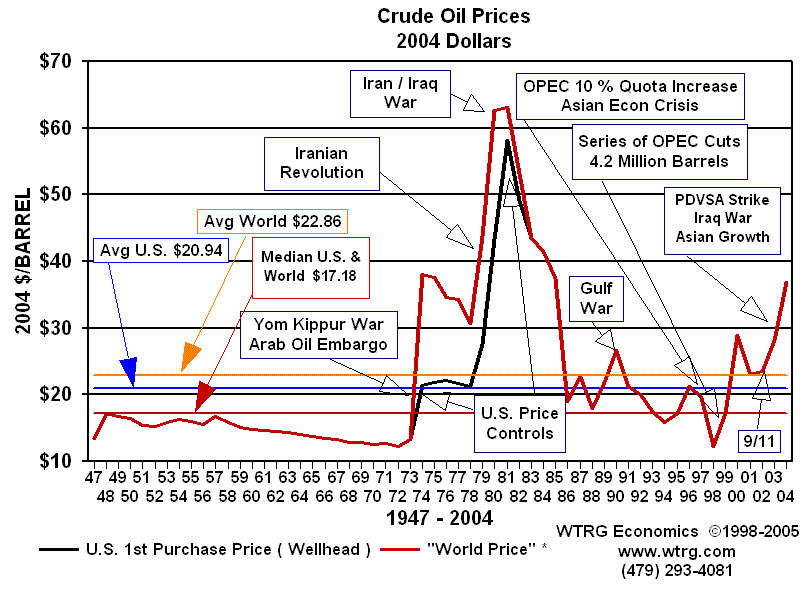
The history of fuel prices closely follows the ups and downs of crude oil prices.

In recent times, the price of crude jumped up from historically low levels below $20/bbl at the time of the Yom Kippur War, when it spiked up to over $40. That was in '73, and besides the dramatic price rise there were shortgages due to an Arab embargo on oil exports to the U.S.

The price remained at that level until the early '80's, when there was another big spike upward at the time of the Iranian Revolution, and it continued to rise during the time of the Iran-Iraq War, when it went up to about $70. People were really hollering then, as the price of gas went way over $2.

But that spike didn't last long, and oil fell gradually over the next few years until it reached very low levels slightly over $20, and even fell below that mark briefly in the late '90's. Never to return, one might add.

As a response to extremely low prices, OPEC cut production and the price started back up, but it didn't really take off until after 9/11. It rose precipitously after 9/11, and then the upward trend became almost vertical in '03, with the Iraq War, more OPEC cuts, and the weakening dollar under the neocon Bush administration.

See this comprehensive and easy-to-read graph at the petroleum market site WTRG.

History matters, and the people who say the catastrophic rise in oil and gas prices occurred during the GW Bush years are right. It probably would have happened even if the Democrats had been in power though. Bush didn't cause peak oil, but his administration didn't respond to the situation, which has now become an emergency. I doubt that any Democrat (except Big Al) would have done more, however.

Global warming -- the twin crisis of peak oil -- began when James Watt invented the steam engine and has spiked in a manner similar to the recent rises in the price of oil over the last 50 years, when fossil fuel consumption doubled, then doubled again. To those who cling to the lies of global warming denial, I can assure you that I saw it with my own eyes when I escaped from California via the Central Valley on the seventh of this month. In California the undebatable effects of human activity on the earth's fragile environment are clearly visible to all but the blind.

~~~~~~~~~~~~~~~~~~~~~~~~~~~~~~~~~~~~~~~~~~~~~~~~~~~~~~~~~~~~~~~~~~~~~~~~~~~~~~~~~~~~~~~~~~~~~~~~~~

Saturday, July 19, 2008

Usury


"The wages of sin is death," the Bible says. I can't cite chapter and verse, but it's in there somewhere.

For the rich man who ignored a diseased beggar named Lazarus camped out at his gate (one of Jesus's parables), the payback for sin was worse than death. Both men died the same night, but the next morning the rich man looked up from the flames of hell to see the beggar resting in the bosom of Abraham in heaven.

That rich man may have been an executive vice-president of IndyMac.

Last night on Bill Moyers' Journal, journalist William Greider talked about the economic sins and crimes of the neocon Bush administration and their role in the "mortgage meltdown," which is shaping up to be another gigantic transfer of wealth from the have-nots to the haves, additional to the gigantic transfer that occurred with the enactment of the Bush tax cuts.

Greider identified the practice that caused the evaporation of billions of dollars of imaginary wealth, which will now have to be paid out to financial institutions as real wealth supplied by the taxpayers (that's you and me) in order to forestall economic collapse, as usury. All three religions "of the book," Judaism, Christianity, and Islam, regard usury as one of the most serious moral transgressions, and those who engage in it as worthy of severe punishment.

For those unfamiliar with the term, Greider explained it succinctly:

Usury, to be clear about it, is rich people taking advantage of poor people by lending them money on terms that are sure to make them fail. All three of the great religions, Judaism, Christianity, Islam, had a moral prohibition against usury because they recognized that society can't function like that. People of great wealth and their institutions like banks naturally have the power to overwhelm people of lesser means. And you can't allow that in a decent society. It won't survive.

(Snip)

Congress repealed the law against usury. It was done in 1980 by a Democratic Congress, Democratic President. And, of course, the Republicans all piled on and voted for it. And that was the first stroke, only the first of many, in which they stripped away the regulatory laws from the financial system and from banking.

And that allowed the free market modernized gimmicks of one kind or another, all these things we're now reading about, to flourish. And that's where we are. I mean, the gatekeepers said to the banking industry and to the financial industry, "We don't think federal control or regulation is good for you, so we're, therefore, liberating you to do your own thing.


The full transcript of this interview is here.

The specific neocon crime in the "mortgage meltdown" occurred when Federal Reserve chief Greenspan became aware of the practice of "sub-prime" loaning and the prevalence of adjustible rate mortgages (ARMs) designed to trap borrowers in unrealistic paybacks -- which are clear-cut cases of usury -- winked at it with his one good eye, and said nothing.

Some people say unregulated free markets will solve all our problems. They're liars, and to hell with them. The "mortgage meltdown" reveals the naked evil of this intentional and deliberate lie. As Jesus made clear, hell is where God will put them if we don't.

Friday, July 18, 2008

Hail, Caesar


I once knew a bright young man who worked very hard. He worked so hard, and was so bright and so on top of things that he became indispensible to the company he worked for. Then, after, he had worked for that company for ten years, he walked across the street and opened his own office, and took half that company's accounts with him.

You might say he was a revolutionary, in his own way.

The Roman aristocrat Octavian was that kind of very bright, very young man when, as Augustus Caesar, he dispatched and eulogized the Roman Republic. Actually, what Augustus did was more just a burial; the dysfunctional, gangster-ridden republic had already been dead for some time. In its place, Augustus erected the military dictatorship we know as the Roman Empire.

Al Gore made a public and well-publicized energy policy statement yesterday. Not young any more but still very bright, Gore pitched a dramatically rational proposal stressing the need to replace a petroleum-based economy with an electricity-based one with all due haste. He made clear why we can delay this necessary conversion no longer.

It is Al Gore, not Barack Obama, who will bring change to this country. Revolutionary change. And the Obama administration will find his authority -- moral and intellectual -- indispensible.

Gore will rule without having obtained his authority through this country's degraded, corrupted, and moribund joke of an elections system. However, this in itself is not particularly revolutionary, since co-rulers have been exercising power through several of the last few administrations without ever having been elected. Who ever voted for Karl Rove, for example?

What is revolutionary is Gore's commitment to the truth as he sincerely understands it. This makes him the exact opposite of the system whose very existence he haughtily refuses to even acknowledge, commonly known as the American political system. The fundamental characteristics of this system are stupidity and frivolity, expressed as televised sound bytes, buzz phrases, and corny quips producing giggles. It has nothing to do with democracy.

He's perfect for the role he's about to assume -- a rich, overweight aristocrat who absolutely refuses to defer to the immaturity and silliness of the network pundits, or the spin of editorial-page writers, or the hysterical barking of fascist personal-attack artists, or the evil mustard gas mutterings of vampires like Charles Krauthammer, or even the dity money of corporate lobbyists. His attitude seems to say "There's no time for that stuff."

Reactionaries fear the truth more than anything. Truth is a fire that lights revolutions, and illuminates the dark corners of privilege and corruption, and the even darker corners of the minds of the members of our ruling class, which largely consists of Neanderthals like Senator Phil Gramm.

Update: Bob Herbert's column this morning (7/19) is on the Gore inititiative. A sample paragraph:

When exactly was it that the U.S. became a can’t-do society? It wasn’t at the very beginning when 13 ragamuffin colonies went to war against the world’s mightiest empire. It wasn’t during World War II when Japan and Nazi Germany had to be fought simultaneously. It wasn’t in the postwar period that gave us the Marshall Plan and a robust G.I. Bill and the interstate highway system and the space program and the civil rights movement and the women’s movement and the greatest society the world had ever known.

When was it?

Now we can’t even lift New Orleans off its knees.

Thursday, July 17, 2008

Creative Vandalism


The great and well-known stencil graffiti artist Banksy started the trend, and now others are picking it up.

(See here for some of Banksy's recent work, and scroll horizontally.)

Illegal, but very high-quality political art is popping up all over. It's saying things you won't hear on the corporate news networks (Action McNews) or even NPR, and is an important expression of populist outrage.

The new kid on the block is Ron English, a legitimate artist doing illegal billboard art. My favorite of his is "Evolution: It's Not for Everyone," which he put up in Spain.

I also like his "Playdate Iran."

The work of Ron English was brought to my attention by Grace Nearing on her blog Scriptoids.blogspot.com.

Any good, competently done, political graffiti in your neighborhood? Take a picture and send it to me via e-mail, and I'll post it here.

DB

Wednesday, July 16, 2008

Summer Idyll

Here in Port Orchard the summer days slide by slowly and silently. Even the few cars passing on the street seem hushed and muted, and only the occasional complaint of a crow or song of a thrush ripples the warm, still summer air.

This is my ninth day here following my escape from California, and I haven't seen this kind of a string of unbroken, warm and sunny weather on Puget Sound since I was a kid growing up here. Over the years the persistence of cool, wet, cloudy conditions seems to have become more and more prevalent with every passing year.

Today the purple mountains, laced with a remnant of winter's snows, are beautiful. The cloudless blue sky and the still blue water reflecting it are beautiful. The trees and lush greenery are beautiful. Even the people are beautiful, if you don't get too close.

How much longer can this last? I'll report back on these conditions in a day or two.

Today I walked the two miles down Pottery Road to Albertson's and back again. On the return trip, carrying a backpack with a few groceries, I broke a heavy sweat trudging along under the warm sun, and my shirts got soaked through. When I was in Desert Hot Springs, I didn't think 75 or 76 degrees could possibly be enough heat to cause a person to perspire, but I was wrong.

Now it's time to go water the yard, and that's another thing most people here have forgotten how to do.

Monday, July 14, 2008

Beautiful Vista Mierda


On a discussion group I frequent, Joe brought up the topic, "'Beautiful ________' (your Village Name)" and commented "The slogan is thrown around here to motivate villagers to become slaves to property 'beauty' while getting them to pay higher property taxes, too. Again, it reminds me of the P. T. Barnum comment."

I never thought of it that way before, but it does make sense now that Joe pointed it out.

Here in Beautiful Port Orchard (and it is beautiful), I guess if people are willing to work hard enough, they too can raise the assessed value of their property.

Probably better to put a '54 Chevy up on blocks out in the front yard, a washing machine or refrigerator (preferably the former) on the front porch, and let the dandelions grow.

I expect to have a bumper crop of crabgrass this year. I'm also trying to get my uncle, the one with the beard who always wears blue overalls and no shoes, to sit on the front porch beside the washing machine with a shotgun in his lap and a gallon bottle of something or other beside his chair.

Now that's what I call property beautification.

Sunday, July 13, 2008

Shadows of Forgotten Ancestors

In 1860, on the eve of America's Civil War, a poor, single seamstress, Mary Hoffman, lived by herself in a boarding house in New York City's tenth ward. At 28, she was approaching the age of what that era designated "spinsterhood," and had little to recommend her, as she was powerless, unconnected, isolated, and alone, among the humblest and lowest rank of proletarian workers in the harsh, dirty, overcrowded city.

Mary found herself pregnant and unmarried, an unacceptable and socially ruinous circumstance in that time, even in the big city. In mid-19th-century America, no one but a prostitute, or "fallen woman," would dare give birth to an illegitimate child, then openly raise it.

She desperately looked for help, and either with the aid of a friend, or possibly because she was a distant blood relative, was able to prevail upon the family of William Andrus, who lived far away from New York City, in the town of Syracuse, near the northern margin of New York State.

Mary Hoffman gave birth to a baby girl in the Andrus home on Lodi Street in Syracuse sometime in 1861 or early 1862. William Andrus, a common laborer, and his wife already had three children, but they agreed to raise Mary's baby, now named May, as their own. Mary left the Andrus home shortly thereafter, and it is doubtful whether she ever saw her child again.

No one knows who May's father was, but I suspect it might have been one Henry Underhill, a 29-year-old single baker whom the 1860 census indicates was boarding in the same house as Mary at that time.

******************************************

May Andrus, for so she was called, grew up in Syracuse and followed her mother in eking out a living with her needle. She was working in a sewing sweatshop in Syracuse when, at age 18 or 19, she caught the eye of the shop foreman, a hot-tempered, domineering young man close to her own age, John Henry O'Connor, the son of Irish immigrants.

The two married and soon began a trek westward, stopping for a while in Lincoln, Nebraska, and then, with the covered wagon and brace of oxen of Hollywood movie fame, followed the Santa Fe Trail to the tiny settlement of Deertrail, in eastern Colorado, where John Henry attempted for the rest of his life, with varying degrees of success or failure, to become a prosperous rancher.

Mary Hoffman went on to marry a rich man, Culver by name, who either was or became a mining entrepreneur in Colorado. Near the turn of the century when she was close to 40, May Andrus O'Connor received a letter from Sallie Norton, a daughter of William Andrus and his second wife. Norton didn't divulge any information about May's mother's marriage, or about Culver, but did inform May that her mother had died, and that at the time of her death she was in possession of a million-dollar mine (which she had probably inherited from her husband). Mary Hoffman, Sallie Norton said, had wanted to cede partial possession of this property to her lost daughter, but the Andrus children -- May's adopted brothers and sisters -- had seized all of it.

As far as we know, May never followed up this information with any attempt to litigate for possession of money and property alleged to belong to her. She lived and died poor. She and John Henry left Colorado and relocated to the Puget Sound region at the ends of their lives, during the Great Depression, and are buried under paupers' gravestones in Hillcrest Cemetery in Kent, Washington.

The reason I know these things is because Mary Hoffman was my great-great grandmother; John Henry and May Andrus O'Connor my great-grandparents. My mother and my sister Christine spent several years digging this history from a fragmented and inchoate mass of letters, photographs, family Bible inscriptions, and census records, then put it together using intensively deductive logic.

Thursday, July 10, 2008

Schwarzenegger in Paradise


"Arnold Schwarzenegger was in Paradise today," said the male voice on the radio.

"Too good to be true," I thought to myself. This was three days ago, on Monday, when I drove the length of California. It costs about $120 in gas, provided you have a car that can get 30 mpg or so.

California, the Golden State, used to be synonymous with Paradise, but on Monday it was more like the sixth circle of Dante's Hell, where heretics are trapped in flaming tombs, and even those are about to be foreclosed upon.

Left Desert Hot Springs at six a.m., got to Bakersfield by ten, I-5 shortly thereafter. Straight up the middle of the state, the Great Central Valley, for the next eight hours. The entire valley -- 600 consecutive miles -- was smogged in, and very hot and sultry. It's what you call an ecological disaster.

Didn't see the big fires, which are over on the coast by Highway One, but I saw a caravan of fire trucks cruising at 65 on their way there.

Some summer or fall in California, the wind will blow over the parched earth, then a bank of clouds off the Pacific will send down dry lightning. Then the whole state will catch fire, and there won't be enough fire trucks or firefighting crews or airpanes or helicopters or fire retardant in the world to put it out.

California has had it, and on Monday I escaped.

In Redding, at the north end of the valley, the temperature was 112-114 at six in the evening, which is about what it had been in Desert Hot Springs, at the other end of the state, the day before.

Spent the night in Dunsmuir, CA, at a pretty, cool spot up the in the mountains, about an hour south of the Oregon line. The next morning I crossed the frontier without incident, and escaped from California about seven. There was no stop at the border; I didn't even have to show my passport.

Saturday, July 05, 2008

The Life of a Blog

I have to leave off writing this blog for a short time.

A person who used to be very dear to me has been hospitalized here in town, in a very serious but inscrutable condition. The doctors are at a loss, and I'm finding the situation very stressful, taxing, and productive of grief.

I'll be back when these difficulties have resolved themselves.

And be assured, I'll be back.

Monday, June 30, 2008

Fantasy Island


On another forum I was encouraged to visit the web address of one Lindsey Williams, a self-appointed energy expert who claims there are more than adequate supplies of petroleum in the world -- easily enough to support two-buck gas and the continued regime of happy motoring.

But I declined to visit Williams's site, because I already know the main outlines of the theory he’s peddling, which consists of equal parts infantile fantasy and snake oil. I call it “The Creamy Nougat Center” theory, and it’s the idea that the earth’s core is spontaneously generating crude oil, which is seeping into the bottoms of the world’s petroleum reservoirs as they are emptied from the top. I hope someone will correct me if I have some aspect of this fundamentally wrong.

Thus desperate and fearful people are lured into believing that there’s just as much petroleum to be had now, or shortly will be as much, as existed at the beginning of the second industrial revolution, ca. 1865 or so.

This, of course, begs the question, “Where is it then? Where is this embarrassment of abundance?“ If, as it was in the beginning, so it now and ever shall be, why has oil production in the U.S. declined every year for over 30 years, by about five percent a year? Why are the Saudis having to pump ever-increasing amounts of sea water into their main field at Ghawar, and relying more and more on horizontal drilling techniques just to maintain current levels of production?

In order to answer those questions, you have to turn to the snake-oil part of Williams’s scenario, the conspiracy theory. I’m less familiar with that part of it than I am with the “creamy nougat” part, since I see no reason to learn the details of complicated, Byzantine, and convoluted scenarios involving the oil giants, Jimmy Carter and the Trilateral Commission, secret meetings at the Bohemian Grove, etc., etc. It suffices to point out that if there was any truth to this conspiracy theory, every bureaucrat in every oil ministry in every country currently struggling to maintain production levels would either have to be in on it, or would have to be an unwitting dupe of the master conspirators -- something that’s clearly impossible.

No credible expert in the field has paid the least notice or given the time of day to these crackpot theories. I’ll cite the Princeton geology professor Ken Deffeyes as an example, and he’s just one of dozens I could cite, who in his commentary on the situation this week bluntly advised, “What do we do? First – admit that there is a problem . . . It's the oil supply, stupid.”

Admit there’s a problem, which is to say, two-dollar gas and happy motoring are gone forever, and little Pollyanna, who sticks out her lower lip and doesn’t want to admit there’s a problem, really is not helping.

All of this reminds me of an incident that happened a few years back when a young friend of mine, on fire with the new life he’d been given by A.A., visited the cirrhosis ward in a large metropolitan hospital. He was sure he’d be able to help some of those poor, suffering bastards. But as it turned out, he couldn’t help any of them, because none of them had a drinking problem. Every single one of them testified that alcohol was not a problem, that “I can take it or leave it.” And this, even though the day of reckoning for them had arrived.

The day of reckoning has been bearing down on us for a long time, and now it’s here. The first thing I did this morning, as I usually do when I get up on Monday, was visit Jim Kunstler’s blog, for his weekly installment of the bad news. And I’ll admit, it does take a strong stomach and some real courage for any normal, ordinary citizen to wrap his or her head around the truth.

But we’ll be a lot worse off if we don’t acknowledge it, and take personal steps to cope with it. The phrase that comes to mind is from Mr. “T” -- he of “A-Team” fame, who always used to say “I pity the fool who…” Yes. And I pity anybody who has not taken some concrete steps in his or her life to deal with these new realities, because you’re getting crushed like bugs.

And just one more thing. Obviously, there’s going to be a third industrial revolution, and the gangbusters new industries that arise during that phase of development will focus on renewable and clean methods of energy generation and energy conversion. There was a time when this country would have been leading the world in investing in, and developing and, yes, selling the new technologies. What happened to us? Why have we become so backward, inept, and unable to deal with the realities of changing conditions?

This is not the America I grew up in.

Saturday, June 28, 2008

What Do You Have?


What do you have when you have a country where the government has "fought many wars," bringing the country "to the verge of bankruptcy?"

--Where "an inefficient...financial system" is "unable to manage the national debt," which is "both caused and exacerbated by the burden of grossly inequitable" (and insufficient) "taxation?"

--Where there is a deep resentment of the continuing "conspicuous consumption" of the ruling class?

--Where there is ongoing and rising high unemployment and inflated prices?

I'd say you have the French Revolution on your hands, from the looks of it.

The major social disruptions usually occur when a society has been experiencing the sort of crisis described above, and then things improve just a little bit. At that point all hell can break loose, as it did in 1789.

This is the year the Republicans will be swept from power. The Democrats will take over, and people will be expecting big improvements. But the Democrats won't deliver the kinds of big changes voters are anticipating.

There'll be some improvement, but there'll also be a lot of foot-dragging. We won't be leaving Iraq any time soon.

That is, unless major social disruptions occur. Could happen.

Friday, June 27, 2008

That Which Never Changes


"God" is a word impossible to get one's head around. "Supreme Being" is almost as bad.

Our yoga teacher -- my daughter's and mine -- sometimes refers to "that which never changes." There's something nearly possible to think about. But what could it be? Everything changes. Even mountains change. Even the universe changes.

But some things change so slowly that for our intentions, for purposes of the length of a human lifetime, they change so slowly and imperceptibly that we can perceive them us unchanging. Holden Caulfield, the protagonist of Salinger's "The Catcher in the Rye," didn't much like the world, but he liked the dioramas at New York's Museum of Natural History ("where I went as a kid") because they never changed.

I've been spending time lately near the three-times-lifesize bronze statue of the Buddha in Golden Gate Park. As far as my limited senses can tell, it never changes. I'm sure it does, really. I'm sure it erodes. But it hasn't visibly eroded since I first visited it in 1965. It was cast in Japan 218 years ago, and brought to where it stands now in 1949. I'll bet it hasn't changed a bit since then.

He reminds me that suffering doesn't change either. For most of us, it comes and goes, but it always remains the one thing all human beings have in common.